




What is a hydrogen tube trailer?
 Author:蓝能
 Times:2025-12-15
 Read:1275
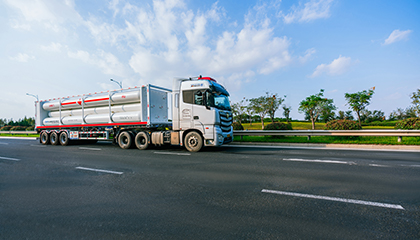
A hydrogen tube trailer is a road-transport system that carries compressed gaseous hydrogen in multiple pressure vessels mounted on a trailer. It delivers hydrogen to industrial users, hydrogen refueling sites and other locations that require a flexible gas supply without a permanent pipeline connection.
Tube trailer pressure, hydrogen payload and usable delivery capacity depend on the vessel construction, rated working pressure, trailer mass limits, receiving pressure and applicable transport requirements. Steel and composite configurations should therefore be compared using verified model data and project operating conditions.
Get a Hydrogen Tube Trailer Recommendation
•Share your required pressure, hydrogen demand and destination country. Our engineering team will recommend a suitable steel or composite configuration.
Key Takeaways
- A hydrogen tube trailer transports compressed gaseous hydrogen in multiple pressure vessels mounted on a road trailer.
- Vessel construction, working pressure and road mass limits influence nominal hydrogen payload.
- Usable delivered hydrogen can be lower than nominal capacity because the receiving system requires a minimum inlet pressure.
- Steel and composite configurations must be compared using verified model data and destination-market requirements.
- Selection should consider hydrogen demand, peak flow, unloading pressure, delivery frequency, interfaces and scope of supply.
How a hydrogen tube trailer stores gas
A hydrogen tube trailer stores gas in clustered “tubes” that are pressure vessels designed and qualified for cyclic service; steel tubes are often built to ISO 11120, while newer composite modules increase payload by reducing tare mass. This configuration allows the trailer to act as both a transport package and a temporary supply bank at the user’s site.
Where tube trailers fit in today’s supply chains
Hydrogen tube trailers fit where a flexible, modular supply is needed—energy pilots and micro-grids, chemical hydrogenation lines, PV/semiconductor tools requiring high-purity purge/reduction gas, and EPC commissioning schedules that cannot wait for permanent infrastructure. In these environments, operators value trailer-as-storage use, routine pre-fill analysis, and clean changeovers to protect product quality and avoid unsafe mixtures during receiving.
Hydrogen Tube Trailer Capacity and Pressure
Hydrogen tube trailer capacity is determined by more than working pressure. Vessel construction, internal volume, tare weight, road mass limits and trailer configuration all influence the nominal hydrogen payload.
The U.S. Department of Energy reports approximately 380 kg of onboard hydrogen for commonly used steel tube trailers and identifies higher payload ranges for newer composite configurations. These figures provide industry context, not a universal specification for every market or REIN model.
The amount of hydrogen that can actually be delivered at the receiving site may be lower than the nominal onboard mass. Usable capacity depends on the trailer’s starting pressure, the minimum inlet pressure required by the downstream compressor or process, pressure losses and the unloading strategy.
| Comparison Factor | Why It Matters |
|---|---|
| Vessel construction | Influences vessel mass, pressure capability and payload |
| Working pressure | Affects stored hydrogen quantity and receiving conditions |
| Total vessel volume | Contributes to nominal hydrogen capacity |
| Trailer tare weight | Reduces payload available within road mass limits |
| Minimum receiving pressure | Determines how much hydrogen remains unusable |
| Peak flow requirement | Affects regulator, piping and unloading design |
| Delivery frequency | Influences fleet size and swap schedule |
| Destination requirements | Affect permitted design and documentation |
Why safety and compliance shape your shortlist
Safety and compliance shape the shortlist because the tubes, valves, and pressure relief devices must align with recognized rules and practices; ISO 11120 sets design and testing expectations for large seamless steel tubes, and industry bodies publish emergency and operations guidance specific to tube trailers that your HAZOP and site procedures can reference directly. Aligning the trailer’s documentation set with these references speeds owner-operator approvals and insurer review.
How a Hydrogen Tube Trailer Works at the Receiving Site
- The trailer arrives and is positioned according to the site procedure.
- Operators secure the vehicle and complete the required pre-connection checks.
- The trailer connects to compatible unloading or pressure-control equipment.
- Hydrogen flows to the process, buffer storage or compressor according to the receiving-system design.
- Available trailer pressure decreases during unloading.
- The trailer is disconnected and replaced or returned according to the operating schedule.
The unloading procedure, grounding, connections, valves, pressure regulation, purging, leak checks and emergency controls must match the site design and applicable requirements.
How to Select a Hydrogen Tube Trailer
- Confirm hydrogen demand in kg/day and peak kg/h.
- Define source and receiving pressures.
- Calculate usable rather than nominal capacity.
- Confirm destination-country road and pressure-vessel requirements.
- Define the delivery scope: trailer only, unloading skid, regulators, telemetry or complete system.
When a station is supplied by tube trailers, hydrogen fueling system sizing must account for declining inlet pressure, usable trailer inventory and delivery frequency.
Filling and Pressure Letdown Operations
Hydrogen tube trailer filling typically involves connecting to a high-pressure hydrogen source—such as an electrolyzer or steam methane reforming plant—and compressing the gas to the trailer's rated service pressure of 200 to 500 bar. The filling process requires strict purge-and-pressurize cycles to eliminate residual air and moisture, with automated leak detection at every valve connection. Pressure letdown during offloading uses a cascade discharge system that steps trailer pressure down through regulator stages, ensuring stable downstream flow rates while maximizing the usable hydrogen extracted per delivery.
Procurement and Project Requirements
Stakeholders quietly optimize different levers around hydrogen tube trailers: distributors look for interchangeable valve/PRD kits and fast requalification cycles; traders compare payload per axle and documentation quality; EPCs prize predictable lead times, lifting plans, and commissioning checklists; fab and PV end users scrutinize impurity limits and pre-fill certificates to avoid tool contamination. Confirming these details before procurement can reduce interface changes and commissioning delays.
Steel vs. composite: a quick field view
The steel-tube trailer is robust and cost-effective for lower-pressure routes or short hauls, while the composite module carries more hydrogen at the same gross vehicle weight—valuable for long routes, islanded grids, and high-throughput pilots. If your site draws steadily all day, higher fill pressure reduces compressor work and trailer swaps; if your draw is peaky, pairing the trailer with a small buffer bank and an automatic changeover panel stabilizes line pressure with minimal capex. (The preferred configuration depends on the verified operating conditions and project requirements.)
Purity, analysis, and who signs off
Purity, analysis, and who signs off should be settled before the first delivery: specify grade (e.g., 5.0/6.0), define pre-fill trailer analysis, and lock sampling points into the receiving skid P&ID. Industry guidance recommends pre-fill analysis of incoming trailers to prevent flammable mixtures and quality excursions—an inexpensive habit that protects tools and supports consistent gas quality and site operating procedures.
A brief note on risk and routing
A brief note on risk and routing is warranted because road conditions, traffic density, and urban routing influence exposure; recent peer-reviewed work models dynamic, traffic-dependent risk for both compressed and liquid hydrogen carriers, offering a structured lens for route selection and terminal procedures. Include the logistics provider and relevant authority in route and site planning when required.
Hydrogen Tube Trailer vs Tube Skid
A hydrogen tube trailer is configured for road transportation. A tube skid uses a modular skid or container-style arrangement that may support transportation, temporary storage or integration with a wider hydrogen system.
The correct choice depends on how the equipment will be transported, positioned, connected and operated. Trailer and skid formats are related options rather than universally interchangeable products.
Why Rein Hytec is a practical partner
Rein Hytec is a practical partner because we design and supply hydrogen tube trailer solutions—steel and composite—matched to 200–500 bar duty, with region-specific conformity, valve/PRD kits, and receiving skids that simplify commissioning. Our team maps your duty cycle (kg/day, peak kg/h), purity, and footprint into a right-sized specification: trailer module, regulators, telemetry, sampling ports, and changeover logic—plus a document set aligned to ISO/EIGA practices so your auditors move faster.
Relevant project or application
Whether you’re supplying a refinery hydrogenation line, a PV anneal bay, or a semiconductor purge system, our team translates flow, purity, and footprint into a clear bill of materials and a realistic timeline.
Share:

Pioneering the future of clean energy,
exploring innovative hydrogen technologies
Contact us for expert storage and transportation solutions