




Hydrogen Refueling Station Cost: Key Equipment and Project Factors
 Author:
 Times:2026-08-28
 Read:
Read:
There is no reliable universal price for a hydrogen refueling station. Cost depends on daily and peak capacity, H35 or H70 fueling, hydrogen supply, compressor duty, high-pressure storage, cooling, dispenser count, site construction, local compliance and the required delivery scope. A useful budget must define the fleet and operating profile before equipment is priced.
Key Takeaways
- Equipment price is only one part of total installed project cost.
- Compression, high-pressure storage and dispensing are major capital items, but their sizes are interdependent.
- A station designed for H70 fast fueling usually needs more demanding pressure and temperature control than a basic H35 fleet application.
- Low utilization can increase the station cost allocated to each kilogram dispensed, even when equipment performs as designed.
- Delivered gas, liquid hydrogen, pipeline supply and on-site production create different equipment and cost boundaries.
- Compare proposals using the same capacity, peak demand, redundancy, site scope, documentation and commissioning assumptions.
What Does “Hydrogen Refueling Station Cost” Include?
Buyers often compare figures that describe different things. A component quotation may cover only the compressor or dispenser. An equipment-package price may exclude civil work, utilities and installation. A turnkey EPC estimate may include engineering and commissioning but still exclude land, hydrogen supply and owner-side costs.
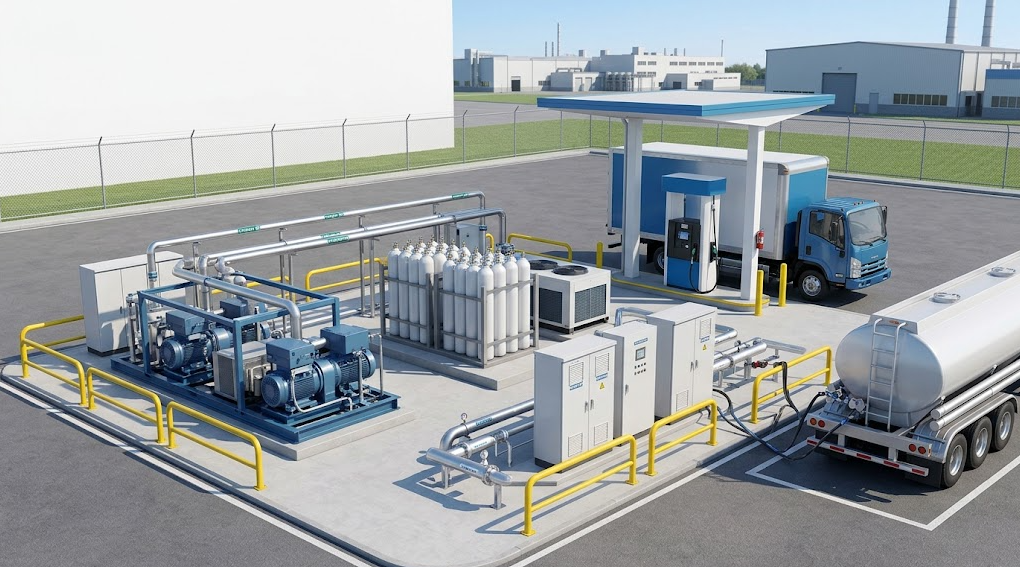
Before comparing numbers, separate three cost levels:
- Equipment cost: major packaged equipment and components;
- Installed project cost: equipment plus integration, construction, utilities, permitting and commissioning; and
- Dispensing cost: the cost per kilogram after capital recovery, energy, maintenance, labor, hydrogen losses and station utilization are considered.
Main Hydrogen Station Cost Factors
| Cost Factor | What Changes the Cost | Information Needed for a Quote |
|---|---|---|
| Capacity and peak demand | kg/day, kg/hour, back-to-back fills and simultaneous fueling | Vehicles/day, kg/fill, peak arrivals and target fill time |
| Pressure class | H35, H70, dual pressure, component ratings and cooling duty | Vehicle OEM requirements and applicable fueling protocol |
| Hydrogen supply | Delivered gas, liquid, pipeline or on-site production | Supply pressure, purity, delivery frequency and backup plan |
| Site and compliance | Civil work, utilities, layout, climate, hazardous areas and approvals | Country, site plan, ambient conditions and required codes |
| Delivery scope | Individual equipment, integrated package, commissioning or EPC | Battery limits, owner responsibilities and documentation list |
1. Station Capacity and Utilization
Capacity should be defined by both daily throughput and the busiest fueling window. A 500 kg/day station serving vehicles evenly across 16 hours can require a different compressor and storage arrangement from a 500 kg/day depot completing most fills in two hours.
The guide on how to size a hydrogen refueling station explains how vehicle demand, peak fills and recovery time work together.
Utilization also affects economics. Capital and fixed operating costs are distributed over the kilograms actually sold. A large station operating far below design capacity can therefore have a high cost per dispensed kilogram. A 2025 peer-reviewed study of heavy-duty refueling found that real-world utilization and liquid-hydrogen boil-off can create substantial penalties compared with idealized cost models. See the study in the International Journal of Hydrogen Energy.
2. Hydrogen Supply Pathway
The supply pathway changes both capital and operating cost. Gaseous hydrogen delivered by hydrogen tube trailers requires unloading, compression and a trailer logistics plan. Liquid hydrogen introduces cryogenic storage, pumping or vaporization and boil-off management. Pipeline supply depends on available pressure and purity. On-site production adds the electrolyzer or other production system, treatment, utilities and buffer storage.
DOE’s H2A delivery framework treats the entire route from production to the vehicle as one pathway. Its HDSAM, HRSAM and HDRSAM models account for transport, conditioning, storage, station design and utilization rather than evaluating a dispenser in isolation.
3. Compressor and High-Pressure Storage
Compression cost depends on inlet pressure, discharge pressure, mass flow, operating hours, redundancy and cooling. For tube-trailer delivery, compressor performance should be evaluated as trailer pressure declines—not only at the highest inlet pressure.
Compressor and storage capacities are linked. A larger hydrogen storage cascade system can support clustered fills and give a smaller compressor more time to restore pressure. A higher-flow compressor may reduce required buffer storage. The lower-cost design is a balance, not the cheapest individual component.
4. H35, H70 and Cooling Requirements
The selected pressure class affects compressor discharge, storage pressure, dispenser components and fueling control. H70 fast fueling can require more demanding temperature management, but project-specific heavy-duty applications may use H35 or H70.
Use the 35 MPa vs. 70 MPa hydrogen fueling systems comparison before pricing the station. A quote based only on “hydrogen station” without the vehicle interface and protocol is not sufficiently defined.
5. Dispensers, Controls and Redundancy
Dispenser cost depends on pressure class, flow, metering, cooling interface, communication, number of hoses and regional conformity requirements. Multiple dispensers may improve access or resilience, but the upstream compressor and storage must support simultaneous demand.
Redundant compressors, backup storage and spare components increase capital cost but may reduce revenue loss and fleet disruption. The correct redundancy level depends on whether the station serves a captive depot, a public network or a mission-critical industrial fleet.
6. Site Work, Engineering and Compliance
Installed cost may include foundations, equipment pads, electrical distribution, cooling water, drainage, ventilation, fire and gas systems, control integration, piping, fencing, traffic management, testing and commissioning. Land, utility upgrades and owner-side infrastructure may remain outside the supplier’s scope.
Local codes and approval procedures affect layout, separation distances, documentation and inspection. These items should be defined before comparing bids because an equipment-only offer and a turnkey EPC proposal are not equivalent.
What Published Cost Data Can—and Cannot—Tell You
NREL’s 2025 Hydrogen Infrastructure Analysis provides transparent model inputs in 2022 U.S. dollars. Examples include approximately $500,871 for one 50 kg/hour, 90 kW compressor; $142,089 for one uninstalled 3.6 kg/min dispenser; $87,916 for a heat-exchanger system; and modeled unit costs per kilogram of storage capacity. The report also applies allowances for balance of plant, installation, engineering, permitting/site preparation and contingency.
These figures are useful for understanding cost structure, not for producing a current project price. They reflect a specific currency year, model version, equipment basis and U.S. assumptions. They should not be presented as 2026 Rein prices or transferred unchanged to another country.
How to Compare Hydrogen Station Quotations
Ask every bidder to state the same basis:
- Guaranteed daily and peak capacity;
- H35/H70 pressure class and vehicle interface;
- Hydrogen inlet-pressure and purity range;
- Number of consecutive and simultaneous fills;
- Compressor redundancy and availability assumptions;
- Storage capacity and usable operating range;
- Dispenser, cooling and control scope;
- Codes, certificates and documentation;
- Installation, commissioning and training scope; and
- Exclusions, utilities and owner responsibilities.
A lower equipment price may not mean a lower installed or lifecycle cost if key interfaces, construction work or redundancy are excluded.
Correctly specifying a hydrogen compressor for a refueling station helps prevent both undersized capacity and unnecessary capital cost.
Request a Project-Specific Cost Review From Rein
Rein provides Hydrogen Refueling Station Equipment including compressors, storage cascades, unloading and filling equipment, sequence control valve groups, dispensers and station controls. Rein also supports system integration and hydrogen engineering services for project-specific requirements.
For a useful preliminary discussion, send the vehicle type, daily demand, peak fueling schedule, H35/H70 requirement, hydrogen supply conditions, project country and required delivery scope.
→ Request a Project Cost Review
FAQs
How much does a hydrogen refueling station cost?
There is no universal price. Capacity, pressure, supply pathway, storage, compressor flow, cooling, dispenser count, site work, compliance and delivery scope must be defined before a meaningful estimate can be prepared.
Which equipment contributes most to station cost?
Compression and high-pressure storage are commonly major capital items, but dispensers, cooling, controls, installation and site work can also be significant. Their costs must be evaluated as an integrated system.
Does a larger station cost less per kilogram?
Potentially, if demand supports high utilization. Economies of scale can be lost when a large station operates below capacity or requires excessive redundancy and site infrastructure.
Is on-site hydrogen production included in HRS cost?
Not automatically. Confirm whether the quotation includes production, purification, compression, storage and utilities or begins at a defined hydrogen inlet battery limit.
Share:

Pioneering the future of clean energy,
exploring innovative hydrogen technologies
Contact us for expert storage and transportation solutions