



What Type of Gas Is Used in an Oxygen Cylinder?
 Author:
 Times:2026-09-14
 Read:
Read:
Most oxygen gas cylinders contain compressed gaseous oxygen (O₂), not ordinary air and not liquid oxygen. The oxygen may be supplied for medical, industrial, laboratory, aviation or other approved use, but its purity specification, cylinder preparation, valve connection, labeling and permitted application depend on the service. Never assume that one oxygen cylinder can be used for another purpose simply because both contain O₂.
Key Takeaways
- A conventional oxygen gas cylinder stores oxygen as a compressed gas.
- Medical oxygen and industrial oxygen are not interchangeable without evidence that the gas, cylinder and filling process meet the required specification.
- Oxygen is nonflammable, but it is a strong oxidizer that can make other materials ignite more easily and burn faster.
- Read the product label and permanent cylinder markings; color alone is not a reliable universal identifier.
- Cylinder selection must consider the required gas specification, working pressure, capacity, valve connection, destination-market rules and usage rate.
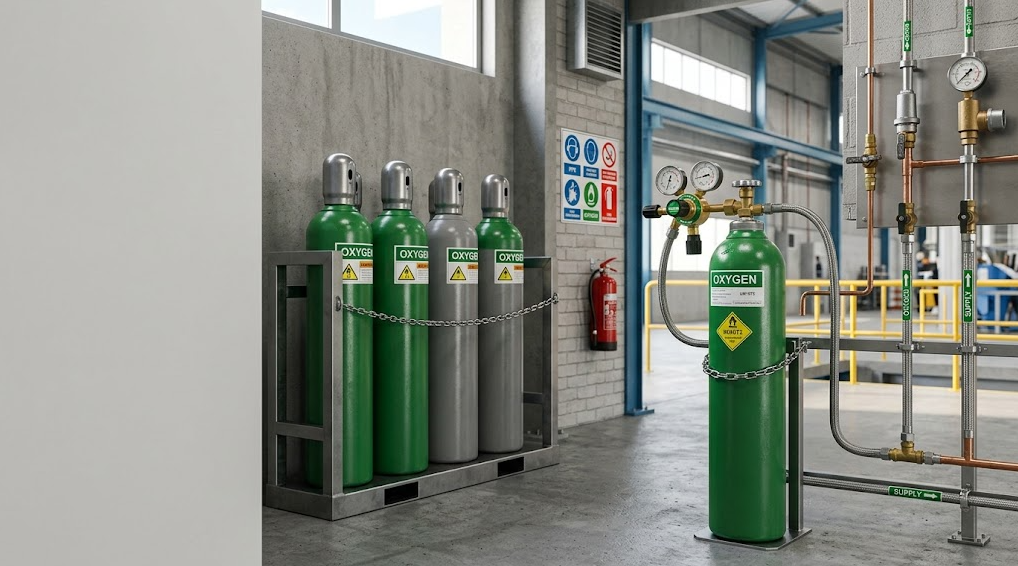
Is an Oxygen Cylinder Filled with Pure Oxygen or Air?
A cylinder labeled for oxygen service is filled with oxygen produced and tested to a defined specification. It is not the same as a compressed-air cylinder. Atmospheric air contains about 20.9% oxygen, with most of the balance being nitrogen, while an oxygen product contains a much higher concentration of O₂ appropriate to its declared grade.
The words “pure oxygen” still need context. No buyer should rely on a generic phrase when a certificate, specification or regulated grade is required. Medical oxygen in the United States, for example, is a designated medical gas when it meets the applicable official compendium standard. The FDA also recognizes a separate “Oxygen 93 Percent” monograph for oxygen produced within its specified concentration range. These are regulated product definitions, not permission to substitute one oxygen source for another.
Common Types of Oxygen Supplied in Cylinders
| Oxygen service | Typical purpose | What must be verified |
|---|---|---|
| Industrial oxygen | Welding, cutting, metal processing, chemical processes and other industrial duties | Required purity, contaminants, pressure, consumption profile and process compatibility |
| Medical oxygen | Patient care through approved medical equipment and prescribed procedures | Pharmacopoeial or national medical-gas requirements, filling authorization, traceability and medical-use valve connection |
| Aviation breathing oxygen | Approved aircraft oxygen systems | Applicable aviation specification, moisture limits, approved cylinder and system compatibility |
| Laboratory or specialty oxygen | Analysis, calibration, research or a controlled manufacturing process | Certified composition, impurity limits, analytical method and certificate of analysis |
| Oxygen-containing mixture | Calibration, medical mixtures or process-specific applications | Every component and concentration; do not describe the mixture as pure oxygen |
The table describes service categories, not universal specifications. Exact grades and acceptance limits vary by country, supplier and application.
How Is Oxygen Stored Inside the Cylinder?
At normal ambient conditions, oxygen in a conventional high-pressure cylinder remains gaseous. Filling more oxygen into a fixed internal volume raises the pressure, allowing a useful quantity to be stored in a portable vessel. The cylinder valve remains closed until an oxygen-compatible regulator or manifold is connected.
Water volume and gas capacity are different measurements. Water volume describes the cylinder's internal physical volume. Available gaseous oxygen depends on the filling pressure, temperature and withdrawal conditions. Buyers should therefore avoid comparing cylinders using water volume alone.
A regulator reduces cylinder pressure to the level required by the downstream equipment. The regulator, valve, hose, seals, manifold and instruments must all be suitable for oxygen service and for the selected pressure range. Connecting a correct cylinder to incompatible equipment does not create a safe system.
Compressed Oxygen Cylinder vs. Liquid Oxygen Tank
An oxygen gas cylinder and a liquid oxygen tank store the same molecule—O₂—in different physical states.
- A conventional cylinder stores compressed gaseous oxygen at ambient temperature.
- A liquid oxygen tank stores cryogenic liquid oxygen near its boiling temperature and normally supplies gas through a vaporizer.
Cylinders are often evaluated for portable, intermittent or lower-volume supply. Bulk liquid systems may be considered when steady demand, cylinder changeovers or delivery logistics justify fixed cryogenic infrastructure. For the complete storage and vaporization process, read Rein's guide to how a liquid oxygen system works.
Why Does Oxygen Cylinder Safety Require Special Attention?
Oxygen itself is not a fuel, but it supports combustion. An oxygen-enriched atmosphere can cause ordinary combustible materials to ignite more easily and burn more rapidly. OSHA consequently requires oxygen cylinders and apparatus used in welding service to be kept free from oil and grease and separated from fuel gases or combustible material under the conditions covered by its standard.
Five practical controls matter across oxygen-cylinder operations:
1. Confirm identity from the label. NIOSH guidance calls for compressed-gas cylinders to be legibly marked with the chemical or trade name. Do not identify the contents from paint color alone.
2. Keep oxygen equipment clean. Never introduce oil, grease, dirty tools or contaminated gloves to oxygen valves and connections.
3. Secure the cylinder. Protect it from falling, impact and unauthorized handling; use suitable cylinder-moving equipment.
4. Use the correct regulator. The pressure rating and connection must match the cylinder and downstream system.
5. Control the environment. Keep cylinders away from heat, ignition sources and incompatible combustibles, with storage arrangements determined by applicable rules.
Opening procedures, leak checks, storage distances and inspection intervals must follow the gas supplier's instructions and the regulations applying at the installation. This article is an overview, not an operating procedure.
How Can You Identify What Is in an Oxygen Cylinder?
Start with the cylinder label and shipping or product documentation. Check the gas name, grade or specification, supplier, hazard information and batch or traceability data where applicable. Permanent shoulder markings normally relate to the cylinder itself—such as manufacturing or test information—and should not be confused with the current gas-product label.
Color conventions vary between markets and services. A familiar color may be a useful secondary cue, but it should never replace the written label. If the label is missing, damaged or inconsistent with the connection or paperwork, isolate the cylinder and contact the supplier rather than testing the contents by use.
How Do You Choose an Oxygen Gas Cylinder System?
Begin with the application and required gas specification. Then give the supplier the operating flow, peak demand, outlet pressure, hours of use, required reserve, installation environment and project country. The supplier also needs to know whether the requirement is for a single portable cylinder, a manifolded bank, a larger storage cascade or another supply arrangement.
For a higher-consumption industrial site, the decision may extend beyond one cylinder. Rein's published industrial gas storage cascade range lists oxygen among the available compressed-gas media, with the final configuration tailored to the gas, pressure, capacity and applicable standard. These products concern compressed gas, not cryogenic liquid oxygen.
Discuss an Oxygen Storage Requirement with Rein
Rein Hytec designs and manufactures storage and transportation equipment for hydrogen, CNG, electronic specialty gases, rare gases and other industrial gases. Rein's public rare and industrial gas equipment page includes customizable compressed-gas storage equipment for oxygen.
For an initial configuration review, provide the oxygen specification, required working and outlet pressure, average and peak consumption, cylinder or cascade preference, project location and applicable code. Rein can then confirm the appropriate product configuration, documentation and commercial scope for the specific project.
Frequently Asked Questions
Is the gas in an oxygen cylinder 100% oxygen?
It is an oxygen product manufactured to a declared grade, but “100%” should not replace the actual specification or certificate. Permitted composition and impurities depend on industrial, medical, aviation, laboratory or other service requirements.
Is medical oxygen the same as welding oxygen?
Both contain O₂, but their regulatory status, filling controls, documentation, traceability and permitted uses differ. Industrial oxygen must not be used for patient care unless it is specifically supplied and authorized as the required medical gas.
Can an oxygen cylinder explode?
A pressurized cylinder can rupture if severely damaged, heated or improperly handled. Oxygen also accelerates combustion. Proper storage, inspection, compatible equipment and trained handling are therefore essential.
Can cylinder color identify oxygen?
Not reliably across every country and supplier. Use the product label and required cylinder markings as the primary identifiers.
Technical References
- OSHA 29 CFR 1910.253 — Oxygen-Fuel Gas Welding and Cutting
- NIOSH — Compressed Gases Safety Checklist
- FDA — Certification Process for Designated Medical Gases
- OSHA Technical Manual — Oxygen-Rich Atmospheres
Share:

Pioneering the future of clean energy,
exploring innovative hydrogen technologies
Contact us for expert storage and transportation solutions