




Why Hydrogen Cascade Systems Matter in Refueling Stations | Rein
 Author:
 Times:2025-05-30
 Read:
Read:
Key Points
- Hydrogen cascade systems divide high-pressure hydrogen storage into low-, medium-, and high-pressure banks to improve refueling efficiency.
- In hydrogen refueling stations, cascade storage helps maintain stable pressure, reduce compressor workload, and support continuous vehicle fueling.
- Cascade systems are especially important for 35 MPa and 70 MPa hydrogen refueling applications, where pressure control and safety are critical.
- Compared with single-bank buffer storage, cascade systems can improve hydrogen utilization and reduce unnecessary energy consumption.
- Rein provides integrated hydrogen storage cascades, tube trailers, refueling station equipment, and engineering services for safe, scalable hydrogen infrastructure.
What Is a Hydrogen Cascade System?
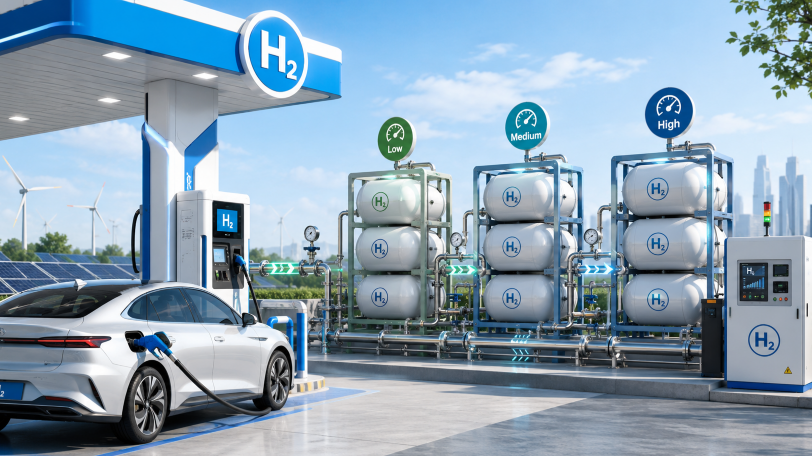
A hydrogen cascade system is a high-pressure gas storage arrangement that separates hydrogen cylinders or vessels into different pressure levels. In a typical hydrogen refueling station, these are often known as the low-pressure bank, medium-pressure bank, and high-pressure bank. Instead of drawing hydrogen from one large storage source, the station fills the vehicle tank step by step from different pressure banks.
This design is widely used because hydrogen refueling is not just about storing gas. It is about delivering hydrogen safely, quickly, and efficiently at the right pressure. For fuel cell vehicles, especially buses, trucks, logistics vehicles, and passenger cars, refueling stations must manage high pressure, changing demand, temperature rise during filling, and equipment reliability.
Rein’s hydrogen storage cascade systems are designed for high-pressure hydrogen supply in refueling stations, industrial gas systems, and energy storage applications. By organizing cylinder banks at different pressure levels, cascade systems help improve hydrogen utilization, reduce compression energy consumption, and ensure stable gas delivery.
Why Refueling Stations Do Not Use One Single Storage Bank
A simple storage system may connect all hydrogen cylinders together at one pressure level. This is often called a buffer storage approach. While it may look easier, it is not always the best choice for hydrogen refueling stations.
Hydrogen vehicle tanks require a controlled pressure ramp during refueling. SAE J2601 fueling protocols cover 35 MPa and 70 MPa hydrogen pressure classes, which are commonly associated with H35 and H70 vehicle fueling. For a station serving multiple vehicles, the pressure inside the station storage system changes constantly. If all storage cylinders are connected as one bank, the compressor may need to work more frequently to maintain the required pressure.
A cascade system solves this problem by using staged pressure banks. The vehicle may first receive hydrogen from the low-pressure bank, then the medium-pressure bank, and finally the high-pressure bank. This allows the station to use available gas more efficiently before relying on the highest-pressure storage or compressor.
How Hydrogen Cascade Filling Works
The basic working principle of hydrogen cascade filling is pressure balancing. Hydrogen flows from the storage bank to the vehicle tank because the storage bank pressure is higher than the vehicle tank pressure. As the pressure difference becomes smaller, the flow slows down. The station then switches to a higher-pressure bank.
| Cascade Stage | Main Function | Why It Matters |
|---|---|---|
| Low-pressure bank | Starts the fill when the vehicle tank pressure is low | Uses lower-pressure hydrogen first and avoids wasting high-pressure gas |
| Medium-pressure bank | Continues the fill as vehicle tank pressure rises | Maintains flow rate and improves gas utilization |
| High-pressure bank | Completes the final stage of refueling | Helps reach target pressure and state of charge |
| Compressor / control system | Recharges storage banks and manages pressure | Supports continuous operation and peak demand |
This staged process is one of the main reasons hydrogen cascade storage is used in refueling stations. Research on refueling systems commonly describes cascade systems as storage divided into low-, medium-, and high-pressure reservoirs, arranged from lower pressure to higher pressure.
This staged process is one of the main reasons hydrogen cascade storage is used in refueling stations. Research on refueling systems commonly describes cascade systems as storage divided into low-, medium-, and high-pressure reservoirs, arranged from lower pressure to higher pressure.
Main Benefits of Hydrogen Cascade Systems in Refueling Stations
1. Better Hydrogen Utilization
Hydrogen is valuable, and high-pressure storage capacity is expensive. A cascade system helps the station use more of the stored hydrogen before compression is required again. By drawing from the appropriate pressure bank at each stage, the station reduces the amount of gas left unused at lower pressure.
This is especially important for stations with high daily refueling demand, such as bus depots, logistics hubs, industrial vehicle fleets, and public hydrogen refueling stations.
2. Lower Compressor Workload
Compressors are among the most important and energy-intensive components in a hydrogen refueling station. If a station relies too heavily on direct compression during every fill, operating costs and equipment wear may increase.
A well-designed hydrogen cascade storage system reduces unnecessary compressor cycling. The compressor can recharge each bank according to pressure priority and demand patterns, rather than constantly responding to every vehicle fill.
Rein provides hydrogen refueling station equipment including unloading/filling cabinets, compressors, sequence control valve groups, dispensers, control systems, system integration, and hydrogen engineering construction services.
3. Stable Refueling Performance
For hydrogen refueling stations, user experience matters. Vehicle operators want predictable filling time, reliable pressure, and safe operation. Cascade storage helps stabilize gas supply by maintaining different pressure levels for different stages of fueling.
This is useful for both light-duty and heavy-duty hydrogen mobility. In fleet applications, several vehicles may arrive within a short time window. Without enough staged storage, the station may struggle to maintain pressure consistency during peak demand.
4. Improved Safety Control
Hydrogen refueling involves high pressure, rapid flow, and strict safety requirements. A cascade system supports safer operation because pressure can be managed in stages instead of relying on one large high-pressure source.
Combined with valves, sensors, pressure relief devices, control panels, emergency shutdown systems, and station-level monitoring, cascade systems help operators manage hydrogen flow more precisely. For buyers, safety should not be evaluated only by the cylinder body. It should include the entire system design: storage vessels, manifolds, valves, compressor logic, dispenser control, ventilation, and maintenance accessibility.
5. Flexible Station Design
Not every hydrogen refueling station has the same demand profile. A city bus station, a mining truck refueling station, a logistics fleet depot, and a public passenger vehicle station may all require different storage capacity, pressure configuration, compressor size, and dispenser layout.
Cascade systems are flexible. The number of banks, cylinder volume, working pressure, and integration method can be customized according to:
- Daily hydrogen demand
- Peak-hour refueling frequency
- Vehicle type: bus, truck, tram, passenger car, special vehicle
- 35 MPa or 70 MPa refueling requirement
- Hydrogen supply method: tube trailer, pipeline, electrolyzer, or liquid hydrogen source
- Available footprint and station layout
- Local safety standards and certification requirements
For stations supplied by gaseous hydrogen delivery, tube trailers and skids are often used together with ground storage and cascade systems. Rein’s hydrogen tube trailers and tube skids are positioned for hydrogen transportation and station supply, with customization options for different project needs.
Cascade System vs Buffer Storage System
Both cascade and buffer storage can be used in hydrogen refueling, but they serve different operating priorities.
| Comparison Item | Cascade Storage System | Buffer Storage System |
|---|---|---|
| Storage structure | Divided into different pressure banks | Cylinders connected at one pressure level |
| Refueling method | Step-by-step pressure transfer | Direct supply from shared storage |
| Hydrogen utilization | Generally higher | May leave more unusable gas at lower pressure |
| Compressor workload | Can be reduced through staged use | May require more frequent compression |
| Control complexity | Higher, requires sequence control | Simpler structure |
| Best for | High-efficiency refueling stations, fleet stations, high-pressure applications | Lower-complexity or specific operating scenarios |
For most modern hydrogen refueling station projects, especially where operating cost, refueling stability, and scalability matter, cascade storage is often preferred.
Why Cascade Systems Matter for 70 MPa Refueling
The higher the target vehicle pressure, the more important pressure management becomes. For 70 MPa hydrogen refueling, the station must deliver hydrogen at very high pressure while controlling temperature and flow rate. A staged cascade system helps preserve high-pressure gas for the final part of the fill, when the vehicle tank pressure is already high.
This is why hydrogen station design often considers cascade filling, booster compression, pre-cooling, pressure ramp control, and dispenser communication as part of one integrated system. NREL reference station work has included 700-bar cascade fill configurations for hydrogen refueling station modeling, showing the importance of cascade design in station architecture.
What Buyers Should Consider When Choosing a Hydrogen Cascade System
For project owners, EPC contractors, gas companies, and fleet operators, selecting a cascade system should not be based only on cylinder price. The better question is: Can the system support safe, efficient, and long-term station operation?
Key factors include:
| Buyer Concern | What to Evaluate |
|---|---|
| Storage capacity | Does the cascade match daily demand and peak refueling frequency? |
| Pressure configuration | Are low-, medium-, and high-pressure banks properly sized? |
| Compressor coordination | Can the compressor recharge banks efficiently? |
| Safety design | Are valves, relief devices, monitoring, and emergency systems integrated? |
| Station layout | Can the equipment fit the available footprint and maintenance space? |
| Certification | Does the system meet project and regional compliance requirements? |
| Lifecycle cost | Does the solution reduce downtime, energy use, and maintenance burden? |
A reliable supplier should be able to provide not only storage equipment, but also system design support, engineering experience, and after-sales service.
Rein Hydrogen Cascade Solutions for Refueling Stations
Rein is a hydrogen and clean energy equipment manufacturer providing storage cascades, tube trailers, refueling station equipment, and onboard hydrogen supply systems. For hydrogen refueling station developers, Rein supports integrated solutions from scheme design to equipment system integration, engineering construction, operation, and maintenance.
Rein’s hydrogen cascade systems can be used in refueling stations, industrial hydrogen supply, hydrogen energy storage, and fleet fueling projects. For customers developing a new hydrogen refueling station, Rein can help evaluate storage capacity, pressure bank configuration, tube skid supply, compressor matching, dispenser integration, and project-specific safety requirements.
Rein also has project experience across global hydrogen applications, including hydrogen refueling stations and storage systems in Asia, Europe, the Americas, and the Middle East.
Conclusion
Hydrogen cascade systems are used in refueling stations because they make high-pressure hydrogen delivery more efficient, stable, and controllable. By dividing storage into different pressure banks, a cascade system helps improve hydrogen utilization, reduce compressor workload, support faster and more consistent refueling, and enhance overall station operation.
For hydrogen station investors, EPC contractors, fleet operators, and gas companies, the cascade system is not just a storage component. It is a core part of the refueling station’s performance, safety, and lifecycle cost.
If you are planning a hydrogen refueling station or upgrading an existing hydrogen supply system, Rein can provide customized hydrogen storage cascades, tube trailers, refueling station equipment, and integrated engineering solutions to support safe and scalable hydrogen infrastructure.
Contact Rein to discuss customized hydrogen cascade systems and integrated refueling station solutions for your project.
Share:

Pioneering the future of clean energy,
exploring innovative hydrogen technologies
Contact us for expert storage and transportation solutions